

Toxicology & the Law | Issue No. 01 | November 2026
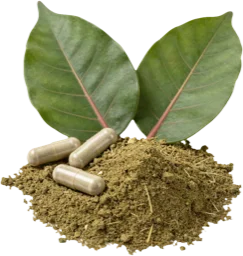
Kratom
A plant-derived substance with opioid-receptor activity, and growing forensic significance
Where medical science meets legal evidence: an attorney briefing from Dr. Sharon S. Kelley.
1. Understanding the Substance
Kratom (Mitragyna speciosa) is a Southeast Asian tree traditionally used for stimulant and analgesic effects. Its principal alkaloid, mitragynine, and the more potent 7-hydroxymitragynine (7-OH) act at opioid receptors. Kratom is not simply interchangeable with prescription opioids; effects depend on product composition and dose. Concentrated 7-OH products warrant particular distinction from ordinary leaf preparations.
2. Appearance and Marketing
Products appear as dried leaves, green-brown powders, capsules, teas, gummies, liquid “shots,” extracts, and concentrated 7-OH tablets. They may be promoted for energy, mood, relaxation, pain relief, or opioid withdrawal. “Natural” does not mean risk-free; potency, labeling, and product purity can vary.
3. Physical and Behavioral Manifestations
Reported effects include stimulation or alertness, euphoria, sedation, nausea, vomiting, constipation, dizziness, sweating, and tachycardia. Serious presentations may involve confusion, seizures, depressed consciousness, or respiratory depression, especially with concentrated products or other sedatives. Repeated use can produce tolerance, dependence, and withdrawal. Clinical effects cannot reliably be predicted from product branding alone.
4. Availability and Legal Status
Kratom is sold through online vendors and some convenience stores, smoke shops, and specialty retailers. As of this publication, kratom alkaloids are not generally scheduled under the federal Controlled Substances Act, but FDA has not approved kratom for medical use, and state restrictions differ. Regulatory treatment of concentrated 7-OH products is evolving. Verify the jurisdiction, product formulation, and law applicable on the relevant date.
5. Kratom in Legal Proceedings
Potential matters include product-liability and failure-to-warn claims, wrongful death, impaired driving allegations, workplace incidents, and disputes over causation. Litigation has raised questions about product warnings, seller responsibility, and whether toxicological evidence adequately establishes a causal connection. The outcome of any case depends on its facts, applicable law, and admissible expert evidence, not merely a positive toxicology result.
The Forensic Perspective
Routine drug panels may not test for kratom alkaloids. Specialized testing can identify exposure, but detection alone does not establish impairment at a particular time or prove causation. Interpretation requires the clinical record, product details, co-exposures, timing, and analytical method.
Selected sources: FDA, “FDA and Kratom”; NIDA, “Kratom”; DEA, “Drugs of Concern: Kratom.” Regulatory status should be checked before use in a particular case.
By Dr. Sharon S. Kelley, PhD, Forensic Toxicologist. Objective toxicological analysis, medical and legal perspectives, expert consultation.
Partner with Toxicology Experts Experienced in the Legal Process.